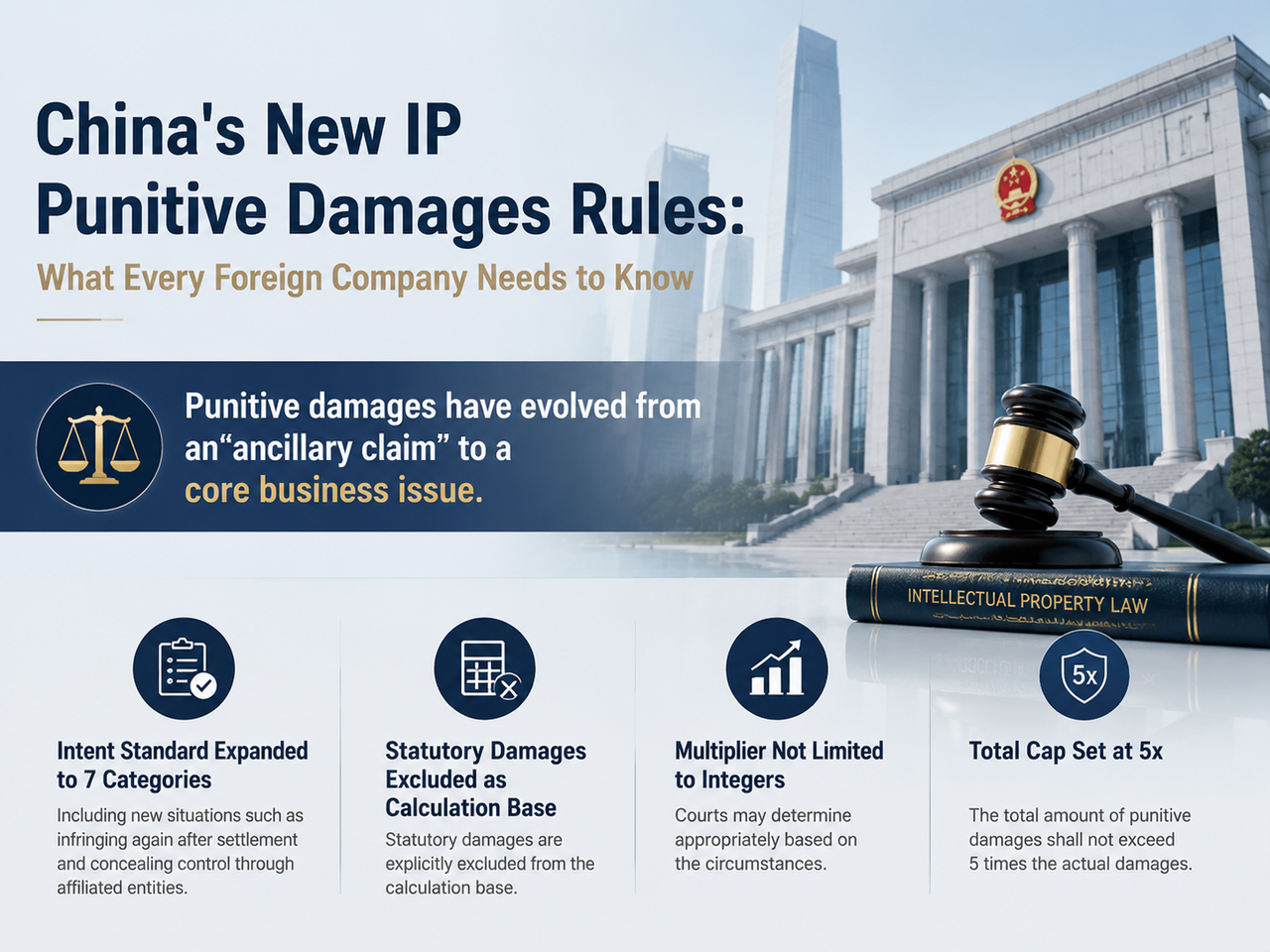
On April 20, 2026, China's Supreme People's Court released the Interpretation on the Application of Punitive Damages in Civil IP Infringement Disputes (judicial explanation〔2026〕7号, effective May 1, 2026), replacing the 2021 version. This is not a minor update. The new rules expand the grounds for finding "willfulness," explicitly bar statutory damages from serving as the calculation base for punitive awards, and introduce mandatory findings for "serious circumstances." The result: punitive damages have moved from a checkbox claim to the central commercial question in high-stakes IP litigation.
This matters if you hold IP rights in China, if you manufacture in China, or if you license technology to Chinese partners.
What Changed: Key Provisions of judicial explanation [2026] No. 7
Direct Answer Paragraph
China's updated punitive damages rules for IP infringement (effective May 1, 2026) do three things that every foreign company must understand. First, they expand the criteria for "willfulness" from 5 to 7 enumerated grounds, including settlement-without-ceasing and concealment of control through affiliates. Second, they explicitly prohibit using statutory damages as the base for any multiplier, forcing rights holders to build actual loss or profit-based calculations from the outset. Third, they cap total punitive awards at 5 times the base, while allowing non-integer multipliers for more precise calibration. If you are a foreign IP holder or a foreign company with Chinese operations, these changes reshape your enforcement strategy and your litigation risk profile.
Expanded Willfulness Criteria: Seven Grounds, Not Five
The 2021 interpretation listed five circumstances where courts could infer willfulness. The 2026 version adds two significant new grounds that directly affect cross-border business relationships:
New ground (vi): Settlement followed by repeat infringement. If a defendant settles a dispute, agrees to cease the infringing conduct, and then resumes the same or substantially similar activity, courts may now directly infer willfulness. This means settlement agreements in China now carry significantly greater weight. Treating a settlement as a negotiating cost rather than a binding commitment to stop is now a documented willfulness trigger.
New ground (vii): Concealing actual control relationships. Defendants who structure their operations through affiliated companies, nominee arrangements, changes of legal representative or controlling shareholders, or use indemnification side-letters to evade IP liability now face direct willfulness findings. Courts can pierce through these structures. If your Chinese business partner has an opaque ownership structure, that opacity now works against them in IP disputes.
Additionally, the existing "piracy and counterfeiting" category has been expanded to explicitly include patent counterfeiting alongside copyright piracy and trademark counterfeiting.
Statutory Damages Blocked as Punitive Base
This is the most consequential procedural change for rights holders. Article 8, Paragraph 3 explicitly states that statutory damages (the court's discretionary assessment when actual losses or profits cannot be determined) cannot serve as the base for a punitive damages multiplier. The former practice of treating enhanced statutory damages as a punitive mechanism is now foreclosed.
What this means in practice: if you want punitive damages, you must build a damages model based on actual losses, defendant's illegal profits, or reasonable royalties from the outset. You cannot file a claim and then rely on the court's statutory assessment to serve as your multiplier base.
> Key conclusion: Rights holders must invest in pre-litigation damages analysis. Forensic accounting, market share studies, and profit tracing are no longer optional. They are the foundation of any punitive damages claim.
Mandatory "Serious Circumstances" Findings
Article 7 transforms several formerly discretionary factors into mandatory findings. Once specific triggering conditions are met, courts shall find serious circumstances exist. These include:
● Repeat infringement after prior administrative penalties or court judgments
● Unjustified refusal to comply with preservation orders
● Forging, destroying, or concealing evidence
● Operating IP infringement as a core business or primary profit source
● Substantial infringement profits or serious harm to brand reputation and market share
● Infringement affecting national interests or public welfare
The practical effect: defendants who exhibit obstructive litigation behavior face compounding consequences. Article 10 allows courts to determine damages based on plaintiff's evidence when defendants refuse to produce accounting records. Combined with Article 7's mandatory serious circumstances findings, obstructive defendants face a three-layer risk stack: mandatory serious circumstances finding, potential base calculation based on plaintiff's figures, and support for higher multipliers.
What This Means for Foreign IP Rights Holders
The Enforcement Opportunity
For foreign companies with registered IP in China, the new interpretation creates stronger tools:
1. Your warning letters now matter more. Article 6(i) allows courts to infer willfulness when infringement continues after effective notification. Document every notice you send, every response you receive, and every instance of continued infringement after notice. Build a dated record.
2. Your settlement agreements now carry real teeth. Under the new ground (vi), a party's promise to stop is now a legally significant act, not just a negotiating gesture. Draft settlement agreements with explicit non-repetition clauses, audit rights, liquidated damages provisions, and representations about corporate structure and beneficial ownership.
3. Profit-based damages are now the only path to punitive relief. You must develop forensic-grade damages models early. Identify the defendant's revenue streams, trace profit margins, and build alternative calculation frameworks (using industry averages or your own profit margins as Article 9 permits) before filing.
4. Affiliate structures work both ways. When investigating potential infringers, map their ownership and control relationships. Structures designed to obscure control now serve as evidence of willfulness.
The Litigation Risk on the Other Side
If you are a foreign company manufacturing in China or licensing technology to Chinese partners, you face new risks:
- Your Chinese counterpart's relationships create liability exposure. If your licensee, distributor, or joint venture partner accesses your technology and then infringes third-party IP, courts may apply Article 6(iii) or (iv) to infer willfulness based on the business relationship and technology access. Due diligence on partners is no longer just a compliance exercise.
- Corporate restructuring does not erase liability. Changing legal representatives, transferring equity, establishing affiliates, or signing indemnification agreements after a dispute arises now signals willfulness, not defensive planning.
- Settlement demands from Chinese rights holders carry higher stakes. If a Chinese IP holder sends you a settlement demand and you continue the same conduct after agreeing to stop, you are now walking into a willfulness trap.
What Foreign Companies Should Do Now
Immediate Actions
1. Audit your IP registration portfolio in China. Ensure all trademarks, patents, copyrights, and trade secrets are properly registered and maintained. The new rules provide stronger enforcement tools, but you can only use them for registered rights.
2. Review all active Chinese business relationships. Map ownership structures, beneficial ownership, and control relationships for every Chinese partner, licensee, distributor, and joint venture. Identify opaque structures that could be used against you or that your partners may attempt to use.
3. Review and revise standard settlement agreement templates. Add explicit non-repetition commitments, audit rights, representations about corporate structure, and liquidated damages clauses. A settlement agreement that merely says "defendant agrees to stop" is now a trigger document.
4. Build pre-litigation damages analysis capability. Establish relationships with forensic accountants or economic experts who can develop profit-based damages models for Chinese IP claims. You cannot wait until after filing to start this work.
Ongoing Compliance Measures
1. Document every IP notice you send. Maintain dated records of all cease-and-desist letters, takedown requests, and infringement notifications in China. These records are now evidentiary foundation for willfulness claims.
2. Conduct IP due diligence on new Chinese partners before signing. This includes mapping their ownership, reviewing their existing IP portfolio for potential conflicts, and assessing their relationships with competitors.
3. Train your China operations team. Ensure that employees in China understand that continued use of technology after a license dispute, even during negotiations, creates litigation risk.
4. Review your manufacturing and supply chain agreements. Ensure your suppliers and contract manufacturers have representations and warranties regarding third-party IP rights, and that they indemnify you for IP infringement claims arising from their products.
Business Impact: Why This Is Different From 2021
The 2021 version was a framework document. Courts were still developing practice. The 2026 version reflects five years of enforcement experience and represents a mature, operationally specific system. Three structural differences matter most:
From peripheral to central. In 2021, punitive damages were often treated as a supplementary claim, filed for completeness but not central to litigation strategy. The 2026 version's explicit rules on calculation bases, mandatory serious circumstances findings, and expanded willfulness criteria make punitive damages a primary commercial consideration in every significant IP dispute.
From vague to actionable. The 2021 version left key terms like "infringement as a business" undefined. The 2026 version provides concrete criteria. This clarity works in both directions: rights holders can now build claims with predictable elements, and defendants can better assess their actual exposure.
From discretionary to constrained. The 2026 version caps total punitive awards at 5 times the base (while allowing non-integer multipliers within that range) and explicitly forecloses statutory damages as a base. This creates a bounded framework rather than unbounded judicial discretion.
For foreign companies, the message is straightforward: IP disputes in China are more consequential than ever. Whether you are enforcing your rights or defending against infringement claims, the financial stakes have risen substantially.
A Note on Trade Secret Protections
One anomaly in the 2026 interpretation deserves attention. Article 5 excludes punitive damages for intentional unfair competition conduct except for trade secrets. This means that if someone steals your trade secrets in China, you can seek punitive damages under the Anti-Unfair Competition Law. But for other forms of unfair competition—passing off, false advertising, commercial disparagement—punitive damages are not available regardless of how egregious the conduct. If your IP portfolio includes both trade secrets and other IP rights, prioritize the trade secret angle when building a punitive damages strategy.
Key Takeaways
- judicial explanation [2026] No. 7 is in force as of May 1, 2026. It replaces the 2021 version and fundamentally reshapes IP enforcement economics in China.
- Willfulness grounds have expanded to seven specific categories, including settlement-without-ceasing and affiliate structure concealment. Courts can infer willfulness from business relationships, prior negotiations, and corporate restructuring.
- Statutory damages cannot be used as the base for punitive awards. If you want punitive damages, you must prove actual losses or illegal profits.
- Total punitive awards are capped at 5 times the base. Multipliers do not need to be integers, allowing more precise calibration.
- Foreign IP holders have stronger enforcement tools, but only if they build damages models and document infringement evidence from the outset.
- Foreign companies with Chinese operations face higher litigation risk from partners, suppliers, and distributors whose conduct they may not directly control.
- Settlement agreements now carry real commitment. Treat every settlement as a binding cessation obligation, not a negotiating gesture.
What's Next
The trajectory is clear: China's IP enforcement system is moving toward the normalization of substantial damages awards. The Supreme People's Court Intellectual Property Tribunal reported 58 punitive damages cases since its 2019 establishment, with cumulative enhanced awards totaling approximately RMB 2.05 billion (about USD 285 million). In 2025 alone, courts applied punitive damages in 30 cases, with total awards reaching approximately RMB 1.13 billion (about USD 157 million). The average per-case award in 2025 exceeded RMB 38 million (about USD 5.3 million).
These numbers will likely rise under the 2026 rules.
If your company holds IP rights in China, manufactures in China, or licenses technology to Chinese partners, now is the time to audit your portfolio, review your agreements, and build your pre-litigation capabilities.

 2026-05-09
 Borsam IP
 粤公网安备 44030902003456号




 Borsam IP