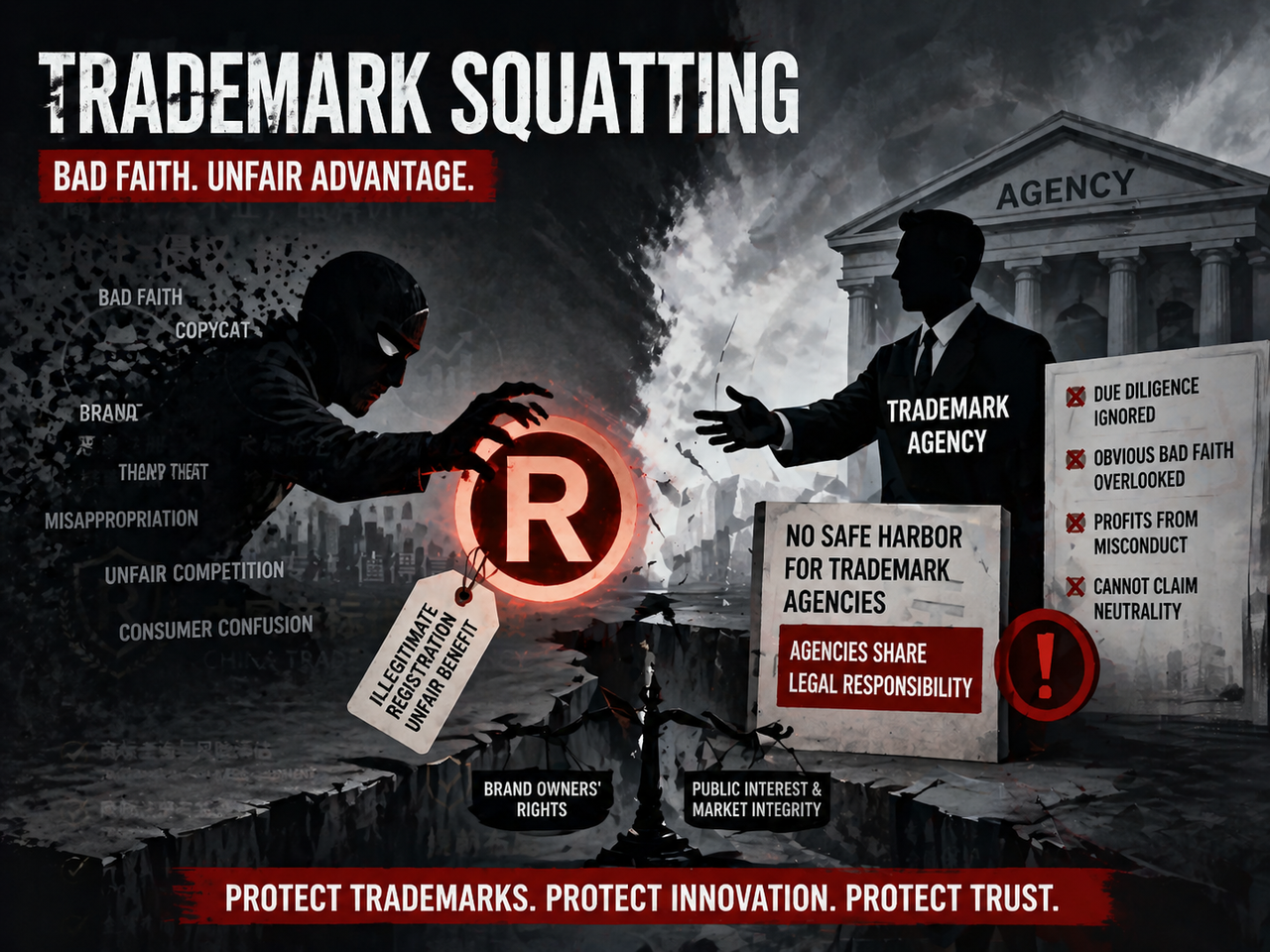
A Chinese court has ordered both a trademark squatter and its registered trademark agency to pay damages jointly for unfair competition, marking a significant shift in how China's judiciary handles repeat malicious trademark registration. The case, decided by Guangzhou Yuexiu District Court and upheld on appeal, awarded 500,000 RMB to the original brand owner and held the trademark agency liable for 100,000 RMB. Foreign brand owners with well-known marks in China can now pursue not only the squatter but also the agency that facilitated the bad-faith registrations.
What Happened in This Case
In April 2026, the Supreme People's Court (SPC) published its annual set of model IP cases for 2025. One of them stands out for foreign brand owners: a repeat malicious trademark squatting case originating from Guangzhou Yuexiu District Court.
The plaintiff, a Guangzhou-based beer company, had been using and registering its "Lan Mei" (蓝妹) trademark since 2001. Starting in 2017, a direct competitor—another company in the beer industry—commissioned a local trademark agency to file more than a dozen look-alike trademarks: "Lan Wei Beer" (蓝味啤酒), "Lan Mei Beer" (蓝魅啤酒), "Authentic Han Lan Mei" (正韩蓝妹), and others.
Several of these applications were rejected or later invalidated by the China National Intellectual Property Administration (CNIPA). But some weren't—and those marks were eventually licensed to third parties for profit.
Previous CNIPA decisions and court rulings had already confirmed that the squatter's applications infringed the original "Lan Mei" mark. Despite this, the competitor kept registering more look-alike marks. That persistence—registering more infringing marks after being caught—became central to the court's analysis.
The court held that the competitor's repeated bad-faith registration campaign went beyond ordinary trademark disputes. It constitutedunfair competition under China's Anti-Unfair Competition Law (2022 revision), which prohibits business actors from leveraging another party's established goodwill without justification.
Damages awarded:

The Guangzhou Intellectual Property Court (Appeal Court) upheld both findings on second instance. The agency's status as a professional intermediary made it especially culpable.
Why This Case Matters for Foreign Companies
Foreign brands operating in or exporting to China face a specific and persistent problem: trademark squatting by local competitors. A company may discover that its well-known foreign brand name has been registered by someone else in China—the world's largest consumer market—often years before the brand ever entered that market.
Historically, foreign brand owners had two main tools:
1. Invalidation proceedings before CNIPA to cancel the squatted mark
2. Civil infringement litigation seeking compensation
Both were available. Both had limitations. Invalidation takes time and requires proving bad faith. Civil suits could recover damages from the squatter, but the squatter might be judgment-proof—a shell company with no assets.
This case changes the calculus by adding a third party to target: the trademark agency.
In China, trademark registration must go through a licensed agency. That agency is supposed to verify the legitimacy of its client's application. The court in this case found that the agency should have known its client was building a portfolio of marks that imitated an established competitor's brand. Accepting that business anyway—particularly for 15 years—crossed the line from neutral service provider to accessory to wrongful conduct.
For foreign brand owners, this matters practically. If a trademark agency can be held liable alongside the squatter, enforcement options expand. Agencies are typically more established, with registered offices, professional licenses, and reputational exposure. Suing the agency may produce a more collectible judgment—or, at minimum, apply real commercial pressure.
The Broader Pattern: Courts Getting Tougher on Bad-Faith Registration
The 2025 SPC model cases reflect a deliberate signal. The court specifically highlighted that this squatter had been caught before—prior CNIPA decisions and court judgments had already confirmed the infringing nature of the marks—yet the company continued filing more applications. The SPC framed this as aggravating conduct that warranted not just trademark law remedies but also Anti-Unfair Competition Law liability.
This aligns with a broader trend in Chinese IP jurisprudence: courts are increasingly willing to treat systematic, repeat bad-faith registration as unfair competition rather than a mere trademark matter. That shift matters because it can affect the scope of damages available and the types of remedies the court will order.
What Foreign Companies Should Do Now
1. Conduct a China Trademark Audit—Immediately
If you sell products or services in China, or plan to, your trademarks must be registered there—regardless of whether you have a physical presence. China operates on a first-to-file principle for most trademark categories, meaning the first person to register a mark in a given class generally gets priority.
Register in your core classes (your actual business), adjacent classes (products you might expand into), and defensively in classes where bad-faith squatters commonly operate.
2. Monitor New Filings in Your Space
Set up watching services through CNIPA databases or commercial providers. When a competitor files a mark similar to yours, you have a limited window to oppose before registration is granted. Waiting until the mark is registered means facing invalidation proceedings instead of opposition—which takes longer and costs more.
3. Build a Documentation File
Chinese courts increasingly award damages that reflect the actual harm or the infringer's illicit gains. To maximize compensation, you need evidence of your brand's reputation in China: market surveys, advertising spend data, sales figures, social media following, and media coverage. Don't wait until a lawsuit to compile this.
4. Consider Naming the Agency in Your Suit
If you are filing a civil action against a trademark squatter, evaluate whether the agency involved acted in bad faith. Courts have now explicitly recognized agency liability. Including the agency as a defendant—or as a third party—may improve your recovery and signal to the market that facilitating squatting carries real costs.
5. Use Administrative Channels in Parallel
CNIPA invalidation proceedings and civil litigation can run simultaneously. Administrative decisions establishing bad faith (e.g., marks invalidated for copying) create a strong evidentiary foundation for subsequent civil suits on unfair competition grounds.
Business Implications
China remains the world's most valuable consumer market and a critical supply chain hub. Foreign brands that skip China trademark registration—or fail to monitor and enforce their marks there—risk watching years of brand equity erode through squatting, counterfeiting, and parasitic imitation.
The good news is that China's IP enforcement environment is genuinely improving. Damages awards are rising. Courts are expanding the scope of liability to reach not just squatters but also the professional intermediaries that enable them. The Lan Mei case illustrates that Chinese courts are willing to apply Anti-Unfair Competition Law to punish deliberate, repeat misconduct that trademark invalidation alone cannot stop.
For foreign brand owners, the message is clear: proactive registration and consistent enforcement are non-negotiable. The legal tools exist. The courts are using them. The only question is whether you are.
If your brand has been targeted by trademark squatters in China, or if you want to build a defensible IP portfolio before entering the Chinese market, contact BORSAM IP for a strategic consultation. We help foreign companies navigate Chinese trademark prosecution, enforcement litigation, and anti-unfair competition claims.

 2026-04-30
 Borsam IP
 粤公网安备 44030902003456号




 Borsam IP