A Chinese seller registers a U.S. design patent for a product their competitor has been selling since 2016. They then file a batch of infringement complaints on Amazon. Ten months later, the competitor's listings are gone, revenue has dried up, and the squatter is capturing the market.
For years, this was the "untouchable" playbook of bad-faith actors—until now.
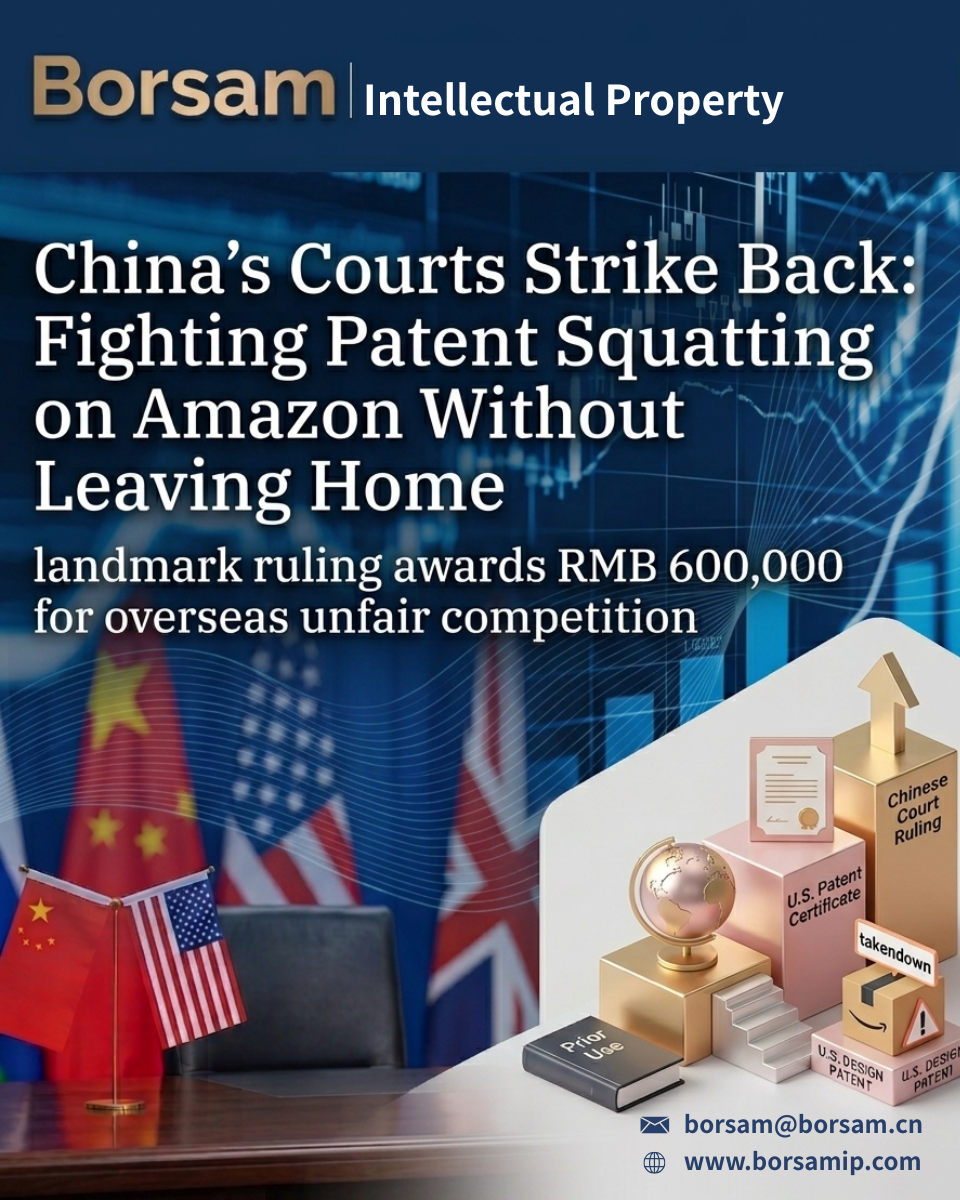
On April 16, 2026, the Guangzhou Baiyun District People’s Court issued a landmark ruling (Case No. (2025) Yue 0111 Min Chu 24695) that strikes at the heart of this strategy. The court found that filing a U.S. patent on a known existing design and weaponizing it via Amazon’s takedown system constitutes unfair competition under Chinese law. The defendant was ordered to pay RMB 600,000 in damages.
This case signals a shift: Chinese courts are now willing to look behind the "veil" of foreign IP registrations to hold domestic parties accountable for bad-faith conduct.
Background of the Abuse
The plaintiff, a veteran Amazon seller, had been selling outdoor inflatable dartboards since 2016. While they had no patent, they had a nearly decade-long trail of production and sales records.
In 2023, a competitor (the defendant) registered an identical U.S. design patent. The connection wasn't accidental: the defendant’s brother had worked for the plaintiff, and the patent applicant was a former employee of the plaintiff’s supplier.
When the defendant claimed they were unaware of the design’s prior history, the judge dismissed the explanation as "inconsistent with common sense" and commercial ethics.
The Legal Logic: Conduct Over Validity
The defendant’s defense relied on a formalist argument: “I hold a valid U.S. patent; therefore, my enforcement on a U.S. platform is legal.”
The Baiyun court rejected this, clarifying the boundary between patent law and competition law:
1. Focus on Conduct, Not Validity: The court did not rule on whether the U.S. patent was "valid"—that remains the USPTO's jurisdiction. Instead, it evaluated the subjective malice of the defendant in China.
2. The "Prior Art" Smoking Gun: The plaintiff’s legal team successfully introduced the U.S. patent’s prosecution history. It showed that the USPTO examiner had actually cited the plaintiff’s own Amazon listing as prior art during a reexamination. The defendant’s persistence in filing complaints despite this knowledge proved "bad faith."
3. Domestic Impact: Since both parties were based in China, the economic harm (lost manufacturing profits and business opportunities) was felt domestically, giving Chinese courts jurisdiction over the "unfair" nature of the act.
Key Takeaway: A foreign patent is not a "get out of jail free" card if it was obtained in bad faith to sabotage a competitor’s legitimate business in China.
The Legal Framework: The "Good Faith" Shield
This ruling is anchored in Article 2 of China’s Anti-Unfair Competition Law, which mandates that market participants act with honesty and credibility.
While earlier drafts of the 2022 amendment suggested an "effects doctrine" (Article 43), current judicial practice—including recent cases in Shanghai Hongkou and Shenzhen Futian—relies on the principle that the abuse of rights to disrupt market order is actionable.
Whether it is a "squatted" EU trademark or a "pirated" U.S. design patent, if the actor is domestic and the motive is malicious, the Chinese legal system is increasingly providing a venue for recovery.
Beyond the Courtroom: The "Schedule A" Context
This ruling arrives as Chinese sellers face an epidemic of "Schedule A" litigation in the U.S. (where hundreds of defendants are sued in a single complaint).
● Between 2016 and 2022, these cases grew from 105 to nearly 1,000 annually.
● Estimated 70% of defendants are Chinese sellers.
● Most settle at a high cost simply because fighting in U.S. courts is too expensive.
The Baiyun ruling provides a "counter-strike" mechanism. If the party behind a bad-faith U.S. lawsuit has assets or operations in China, the victim can now bring the fight to a forum where they have the evidentiary and home-court advantage.
Practical Defense Strategy for Cross-Border Sellers
To leverage this legal trend, businesses should adopt a proactive IP hygiene strategy:
1. Archive Your "First-to-Market" Evidence: Maintain a "Prior Use Folder" for every product. This includes timestamped design drafts, mold invoices, shipping containers (BOLs), and the original date of your first Amazon listing.
2. Monitor the USPTO/EUIPO: Regularly search for your product keywords in foreign patent databases. If you find a competitor has filed for your design, initiate a "Letter of Protest" or reexamination immediately.
3. Track the "Human Connection": Keep records of former employees or suppliers who move to competitors. In bad-faith cases, proving the defendant knew about your product is the most critical hurdle.
4. Use Domestic Injunctions: If a competitor is using a bad-faith foreign patent to freeze your Amazon funds, consider filing for a "Declaratory Judgment of Non-Infringement" or an Unfair Competition suit in your local Chinese court to pressure them into a settlement.
Conclusion: The Baiyun judgment confirms that the "wild west" of overseas patent squatting is closing. For brand owners and manufacturers, the message is clear: Document your history, protect your designs, and don't assume a border will protect a bad actor from the reach of Chinese law.

 2026-04-24
 Borsam IP
 粤公网安备 44030902003456号




 Borsam IP