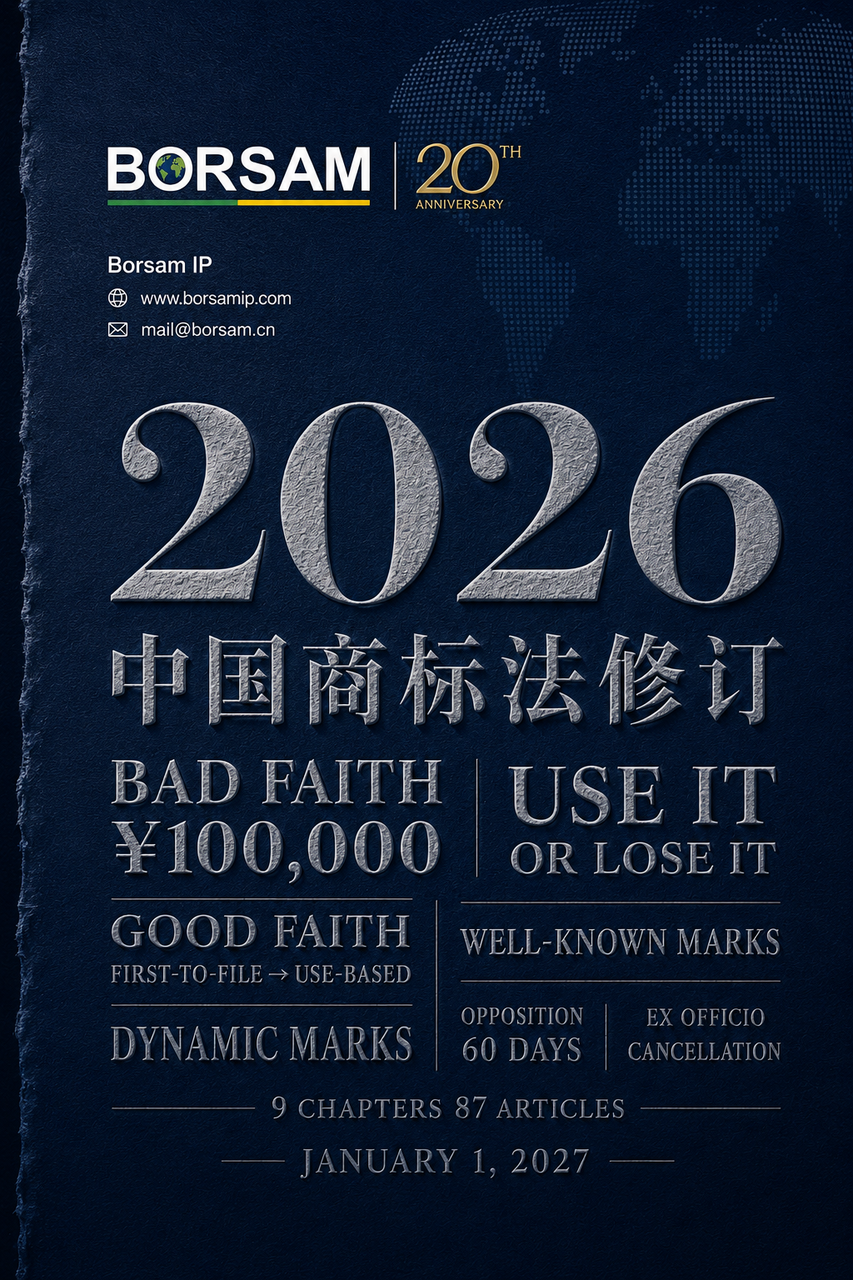
On June 26, 2026, the Standing Committee of China's National People's Congress passed the most comprehensive revision of the Trademark Law since the statute was first enacted in 1982. The new law—9 chapters, 87 articles, effective January 1, 2027—is a structural rewrite. It shifts China's trademark system from a pure first-to-file regime toward one anchored in actual use, good faith, and genuine commercial activity. Foreign companies with brands in China have roughly six months to get their house in order.
This is not another incremental amendment. The 2013 and 2019 revisions were surgical—they added penalties, shortened timelines, introduced sound marks. This one tears down the old architecture and builds something different. If your China trademark strategy was built on the assumption that filing early and filing broadly was enough, that assumption expires on December 31, 2026.
Why this revision matters now
China's trademark registry has been drowning in bad faith filings for years. By the end of 2025, the country had 53 million valid trademark registrations—more than the rest of the world combined. In 2025 alone, CNIPA registered 4.2 million trademarks, though that number was down 12 percent from 2024, partly due to tightening examination. The scale of the problem made incremental fixes inadequate. The new law addresses the root cause: a registration system that rewarded speed over substance.
For foreign brands, the stakes are immediate. China remains a first-to-file jurisdiction. The difference now is that the system actively punishes those who file without intent to use. If a local competitor or trademark squatter files your brand name in bad faith, you have better weapons to fight back. But you also face tighter deadlines, higher evidentiary standards, and new risks if your own portfolio contains unused registrations.
What actually changed: the provisions that matter
Bad faith filings now carry financial penalties. Article 54 authorizes fines of up to RMB 100,000 for malicious applications. Three categories are targeted: filing marks that violate explicit prohibitions, filing without intent to use and manifestly exceeding normal business needs (Article 19), and intentionally violating well-known mark protections or preemptively registering marks already in use. This is new. Under the old law, a rejected bad faith application cost the filer nothing beyond the filing fee. Now it carries real financial exposure.
The opposition window shrinks from three months to two. Article 36 gives you 60 days to oppose a published application. That is tight. Monthly trademark watching stops being optional. If you rely on quarterly audits, you will miss applications that publish between reviews. For foreign companies managing China portfolios through outside counsel with quarterly reporting cycles, this requires an operational change now.
Dynamic marks are now registrable. Article 14 adds dynamic marks to the list of protectable sign types—alongside words, devices, 3D shapes, colors, and sounds. For consumer brands, luxury houses, and tech companies with animated logos or motion graphics, this opens a new layer of brand protection in China. The same article extends the functionality exclusion to all non-traditional marks, meaning a dynamic element that is technically necessary for the product cannot be monopolized as a trademark.
Use it or lose it gets sharper teeth. Article 57 gives CNIPA the power to cancel registrations ex officio—on its own initiative—if a mark becomes generic or goes unused for three consecutive years without justification. This matters for foreign brands that maintain defensive portfolios of marks they do not actively use. Those registrations are now more vulnerable. Separately, Article 78 codifies the rule that a rights holder who cannot prove use of its mark during the three years before filing suit cannot recover damages. Registration alone does not support a damages claim.
Well-known marks get broader protection. Article 21 eliminates the distinction between registered and unregistered well-known marks for cross-class protection. Previously, only registered well-known marks could block applications in different classes. Now unregistered well-known marks get the same reach. The evidentiary burden to prove fame remains high—market survey data, revenue records, advertising spend, enforcement history—but the legal framework is more generous than before.
Fair use gets a statutory home. Article 73 provides explicit defenses for generic names, descriptive terms, functional features, and nominative or indicative use. If you use a competitor's mark solely to describe compatibility, intended purpose, or application context—and you do not create confusion about source or sponsorship—the rights holder cannot stop you. This codifies what good practitioners already understood but courts applied inconsistently. E-commerce sellers, aftermarket parts manufacturers, and repair services benefit most directly.
Agency regulation tightens across the board. Articles 65 through 68 impose registration requirements, conduct standards, and escalating fines on trademark agencies and individual practitioners. Agencies that knowingly assist bad faith filings face fines up to RMB 200,000 and potential suspension. Practitioners working at multiple firms simultaneously or accepting side work face fines up to RMB 100,000. For foreign brands, this means the quality and compliance of your China trademark agent now carries legal consequences for the agent—which in turn affects the quality of filings you receive.
Malicious litigation gets a statutory prohibition. Article 81 authorizes courts to penalize parties who file trademark suits through malicious collusion or by fabricating facts. The defendant can recover civil damages. This targets a pattern that plagued the system: entities acquiring weak or improperly obtained registrations, then using them to sue legitimate operators and extract settlements. The provision does not chill legitimate enforcement, but it creates real downside for abusive litigation.
What foreign companies should do before January 1, 2027
The law gives you a six-month runway. Do not treat it as optional reading.
First, audit your China portfolio. Identify every registration you hold but do not use. Determine which ones serve genuine defensive purposes tied to active business lines and which are legacy holdings without current commercial relevance. The unused ones are now at risk of ex officio cancellation and will not support damages claims in infringement actions.
Second, tighten your watching. Move to monthly trademark monitoring. The two-month opposition window means that a report sitting in someone's inbox for three weeks before review could cost you the opposition deadline. Set up automated alerts. Brief your local counsel that response times need to compress.
Third, collect use evidence now. For every mark you actively use in China, gather sales contracts, invoices, advertising records, packaging samples, e-commerce listings, social media posts, exhibition materials. Organize them by mark, by year, by product category. When a dispute arises, you will need to show use within three years of filing suit. Building the evidence file after the dispute starts is expensive and incomplete.
Fourth, review your agency relationships. Confirm your Chinese trademark agent is properly registered. Ask about their compliance infrastructure. An agent who cuts corners on filings to reduce costs is now a liability for you—because an agent facing suspension or fines cannot effectively manage your portfolio.
Fifth, evaluate non-traditional marks. If you have animated logos, motion graphics, or dynamic brand elements, assess whether they meet the distinctiveness threshold and are not purely functional. File before the law takes effect if possible, to lock in the pre-revision examination framework.
Finally, if you hold well-known marks, reassess your cross-class protection strategy. The elimination of the registered-versus-unregistered distinction for cross-class blocking means unregistered well-known marks now have broader defensive reach. But you still need to prove fame. Start building the evidence package now.
The commercial reality
This is not a law that makes China harder for foreign brands. It makes the system harder for bad actors. The brands that suffer under the new regime are those that file without using, that litigate without substance, that rely on procedural gamesmanship rather than genuine commercial presence. The brands that benefit are those that actually sell products, build recognition, collect evidence, and monitor the registry.
The six-month window is generous by Chinese legislative standards. Use it. The brands that treat this as a paper compliance exercise will wake up in 2027 with vulnerabilities they could have addressed. The ones that treat it as an operational priority will find the new system more protective, not less.

 2026-07-03
 Borsam IP
 粤公网安备 44030902003456号




 Borsam IP