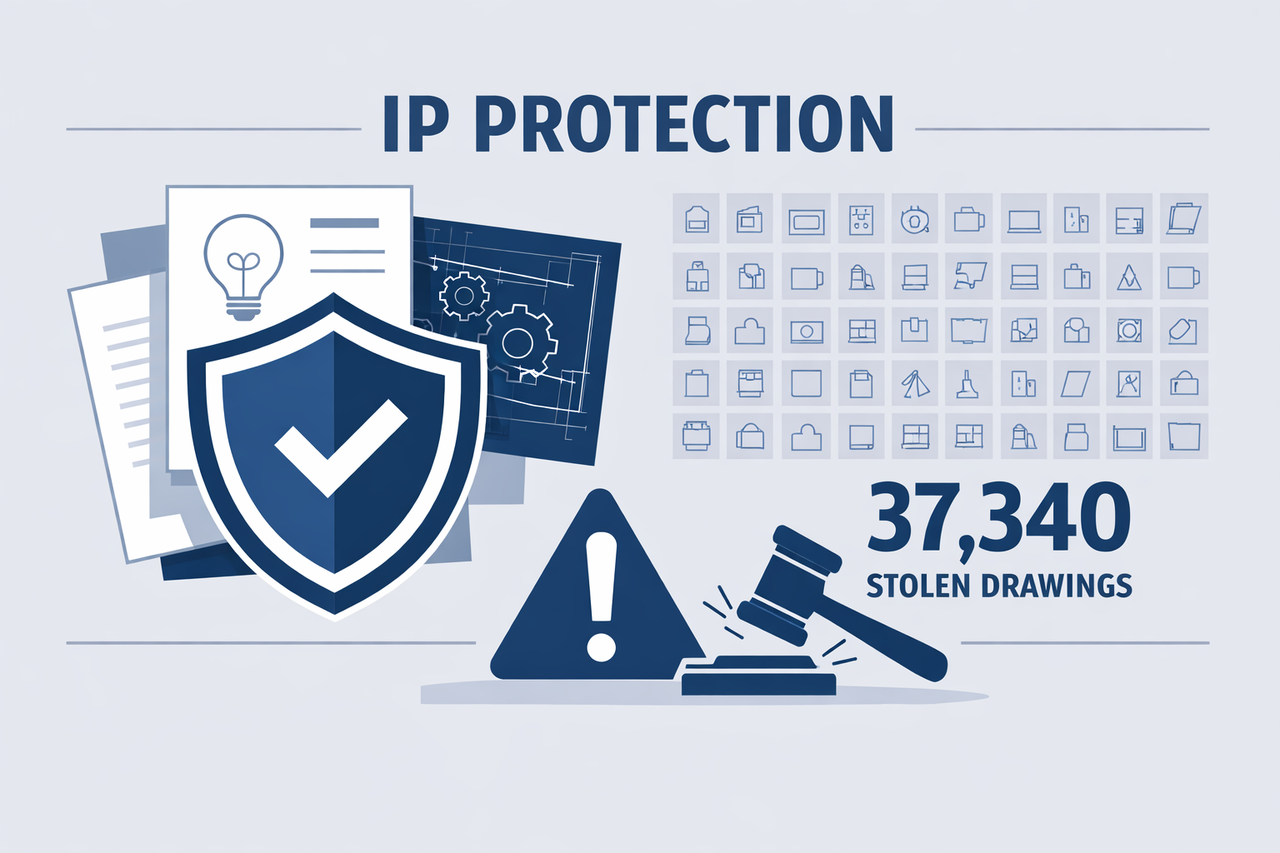
A former employee stole 37,340 drawings. The Supreme Court just handed down a record-breaking penalty.
The Numbers That Matter
In December 2025, China's Supreme People's Court closed a trade secret case with a final judgment that sent shockwaves through the manufacturing sector: 380 million yuan in damages (roughly $53 million USD).
This isn't just another IP dispute. It's the highest trade secret compensation award in China's history, and it signals a dramatic shift in how courts handle industrial espionage.
The parties:
· Plaintiff: Beijing Jingdiao Technology Group — CNC machine tool manufacturer
· Defendant 1: Tian, a former Jingdiao employee (14 years on the job)
· Defendant 2: Shenzhen Genesis Machinery, a subsidiary of Guangdong Genesis Intelligent Equipment Group
Key figures:
· Stolen materials: 37,340 technical drawings and documents
· Time employed before theft: 14 years
· Infringement period: Approximately 6 years (2017-2023)
· First instance award: 12.3 million yuan + 500,000 yuan legal costs
· Second instance award: 379.63 million yuan + 2 million yuan = ~382 million yuan total
· Punitive multiplier: 3x (statutory range is 1-5x)
How It Went Down
The Long Game
Tian didn't rush. Over 14 years at Jingdiao, he systematically downloaded core technical documents to personal devices before resigning. We're talking about 37,340 CNC machine design drawings — essentially the company's entire product DNA.
This wasn't a smash-and-grab. It was patient, methodical, and nearly invisible until it was too late.
The Jump
Tian left Jingdiao and immediately joined Shenzhen Genesis. According to the plaintiff, the infringing products were virtually identical to Jingdiao's core technology — copy-paste engineering at industrial scale.
Criminal Charges Didn't Stop the Bleeding
Here's where it gets interesting: Tian was already criminally prosecuted for trade secret theft before the civil case. But that didn't stop Shenzhen Genesis from continuing to use the stolen technology in production and sales.
That decision would prove expensive.
Digging In During Litigation
Court records indicate the defendants engaged in less-than-cooperative litigation tactics — incomplete evidence production, questionable statements, and general obstruction. These behaviors didn't go unnoticed when the court calculated punitive damages.
The Math Behind $53 Million
Why 37,340 Drawings Counted as One Secret
The core dispute: Should the court protect individual technical points identified in the criminal proceeding, or treat all 37,340 drawings as an integrated technical database?
First instance court took the narrow view — only specific technical points counted, resulting in the relatively modest 12.3 million yuan award.
The Supreme Court disagreed. In its second instance ruling, the court held:
The tens of thousands of stolen drawings constitute a "complete systematic technical information database."
Even if individual pieces became public, the overall scheme remains protected as a trade secret.
This breaks from the traditional separation between criminal and civil proceedings. The entire database gets protection as a unit.
Calculating Damages: Three Steps
Step 1: Establish the Base
The court independently calculated infringement profits from April 2019 to March 2023 using the defendant's parent company annual reports, sales data, and audit records.
Public filings show infringement profits ranged from 127 to 161 million yuan (different disclosure standards produced varying figures).
The court applied different profit margins by period:
· 2017-2018: Referenced 23% margin
· 2019-2022: Actual margins 16.77%-22.19%
· 2023: Referenced 2022's 22.19%
Step 2: Apply Punitive Multiplier
Under Article 17 of China's Anti-Unfair Competition Law, willful trade secret infringement with serious circumstances can trigger punitive damages of 1 to 5 times actual losses or infringer profits.
The court applied 3x punitive damages based on:
· Deliberate theft (systematic downloading during employment)
· Long-term, large-scale production (roughly 6 years)
· Continued infringement after criminal prosecution
· Litigation misconduct
Step 3: Final Tally
· Stop using disclosed secrets (until publicly known)
· Destroy all documents containing trade secrets
· Pay 3.9354 million yuan in court fees
The 100% Contribution Presumption
One of the most significant aspects: the court presumed 100% technical contribution from the stolen secrets.
Defendants argued their products incorporated other technologies beyond the stolen secrets. The court's response: if the infringing products relied entirely on the trade secrets, the burden shifts to defendants to prove otherwise. They couldn't, so 100% it is.
This burden-shifting approach could reshape how similar cases are litigated.
What This Signals
From "No Complaint, No Case" to Zero Tolerance
This is the Supreme Court's landmark application of punitive damages in high-end equipment manufacturing since the 2019 Anti-Unfair Competition Law amendments.
The message is clear: willful infringement will be punished at the top end of the statutory range.
High-Tech Manufacturing Is in the Crosshairs
This represents the highest trade secret damages ever awarded in the CNC machine tool sector.
Expect ripple effects across:
· Machine tools, semiconductors, industrial automation
· "Poach-and-carry" hiring strategies now carry massive liability
· IP compliance during employee transitions is no longer optional
New Rules of the Road
The judgment establishes several precedents:
Based on lessons from this case, here's what companies should consider:
Technical Controls
· Tiered access: Restrict drawing access by sensitivity level — no exceptions, even for senior engineers
· Encryption: Store core drawings encrypted; disable export functions where possible
· Audit trails: Log all viewing, downloading, and printing of sensitive documents
· Digital watermarks: Embed invisible tracking markers in drawings for leak trace
Policy Infrastructure
· Non-compete agreements: Execute for all sensitive positions with clear breach consequences
· NDA coverage: From onboarding through exit interviews
· Exit audits: Technical review before key personnel departures
· Regular training: IP compliance isn't a one-time checkbox
Evidence Readiness
· Document secrecy: Maintain R&D records and confidentiality measure documentation
· Market monitoring: Regular sweeps for infringing products
· Notarization: Preserve evidence promptly upon discovery
· Response team: Designate personnel trained in IP enforcement

 2026-03-20
 Borsam IP
 粤公网安备 44030902003456号




 Borsam IP